

The Science of Wealth Creation: How Money Grows Over Time
For many, wealth creation feels like a closely guarded secret—a mixture of luck, timing, and complex financial maneuvering. But strip away the jargon, the stock market tickers, and the noise of daily news, and what remains is remarkably straightforward. Wealth creation is not magic; it is a mathematical science. It relies on a few fundamental principles that, when applied consistently, produce predictable and extraordinary results.
At GrowSIP, we view this process as an operating system for your financial life. Just as a well-written code runs efficiently in the background, a properly structured financial plan works quietly over the decades to turn steady savings into significant wealth. The engine powering this entire system is the concept of compounding.
To understand how money grows, we must shift our perspective from thinking about money as something we simply spend or save, to viewing it as a tool that can be put to work.
The Engine of Growth: Understanding Compounding
Albert Einstein is often reputed to have called compound interest the “eighth wonder of the world.” Whether he actually said it or not, the mathematical truth behind the statement stands. Compounding is the process where the returns you earn on your original investment begin to earn returns themselves.
In simple interest, your money grows in a straight line. If you invest ₹1,00,000 at 10% simple interest, you earn ₹10,000 every single year. After 10 years, you have earned ₹1,00,000 in interest.
Compound interest, however, operates on an exponential curve. It is money making money. When you earn that first ₹10,000, your new base becomes ₹1,10,000. The next year, you earn 10% on the new total, meaning your interest is ₹11,000. Over a few years, this difference seems small. Over decades, it creates a financial avalanche.
The science behind this growth is governed by a specific mathematical formula:
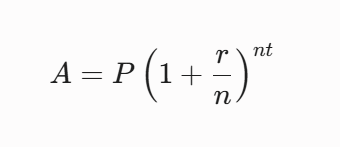
uHere is what each component of this equation represents in the real world:
- A (Total Wealth): The final amount you will have accumulated.
- P (Principal): Your initial investment, or the seed capital.
- r (Rate of Return): The annual growth rate (the “soil” in which your money grows).
- n (Compounding Frequency): How often your returns are reinvested (e.g., annually, monthly).
- t (Time): The number of years your money is allowed to grow uninterrupted.
While the math is absolute, the human behavior required to see this formula through is where most people struggle.
The Three Pillars of Financial Growth
To build a robust operating system for your wealth, you must optimize the three main variables of the compounding equation: Capital, Rate of Return, and Time.
1. Capital (The Seed)
You cannot grow a tree without a seed, and you cannot compound wealth without capital. In the context of Indian wealth builders, capital is usually generated through active income—your salary or business profits.
The key here is the savings rate. It is a common misconception that you need a massive lump sum to start investing. The reality is that systematic, regular investments (like a Systematic Investment Plan, or SIP) are far more effective for the average person. Investing ₹5,000 or ₹10,000 consistently every month trains your financial operating system to prioritize asset accumulation before consumption.
2. Rate of Return (The Soil)
The rate of return is how fast your money multiplies. Where you park your money determines its growth rate.
- Savings Accounts (3-4%): Highly safe, but growth is slower than inflation.
- Fixed Deposits (6-8%): Stable and guaranteed, but often fail to create massive long-term wealth after taxes.
- Equities/Mutual Funds (10-14% historically): Volatile in the short term, but historically the most powerful vehicle for long-term wealth creation.
Note: Equity returns are never guaranteed and come with market risks. The historical average simply helps us model potential future growth.
3. Time (The Season)
Time is the exponent ($t$) in the compounding formula. Mathematically, an exponent has a vastly larger impact on the final result than the base numbers. In wealth creation, time does the heavy lifting. The longer you leave your money invested, the steeper the curve of wealth accumulation becomes.
Visualizing the Journey: The Hockey Stick Curve
To truly grasp how these variables interact, you need to see the compounding curve. The first few years of wealth building are often described as “boring.” If you invest consistently, your total wealth will mostly consist of your own hard-earned contributions.
However, cross a certain threshold—usually around the 7 to 10-year mark—and a shift occurs. Your returns start generating more wealth than your actual monthly contributions. This creates a “hockey stick” effect on a graph, where a flat line suddenly shoots sharply upwards.
Key insight: Play with the time slider in the visualization above. Notice how changing the timeframe from 10 years to 20 years doesn’t just double the final amount—it multiplies it exponentially. The last few years of a long-term investment journey generate the vast majority of the total wealth.
The Power of Starting Early: A Tale of Two Investors
To understand the practical impact of the science of compounding, let’s look at a hypothetical comparison between two investors: Aditi and Rohan. Both want to retire at age 60, but they approach the timeline differently.
Aditi understands the science of time. She starts investing at age 25. She invests ₹10,000 every month via an SIP into a diversified equity portfolio.
Rohan decides to wait until his career is more established. He starts investing at age 35. Realizing he has lost a decade, he decides to invest double the amount—₹20,000 every month—to catch up.
Assuming both receive a hypothetical annualized return of 12%, here is how their wealth stacks up at age 60:
| Investor | Age Started | Monthly SIP | Total Capital Invested | Wealth at Age 60 (at 12% p.a.) |
| Aditi | 25 | ₹10,000 | ₹42,00,000 (42 Lakhs) | ~₹6.4 Crores |
| Rohan | 35 | ₹20,000 | ₹60,00,000 (60 Lakhs) | ~₹3.7 Crores |
Despite Rohan investing significantly more of his own hard-earned money out of pocket (₹60 Lakhs vs. Aditi’s ₹42 Lakhs), Aditi ends up with nearly double the wealth.
Why? Because Aditi’s money had 35 compounding cycles, while Rohan’s only had 25. Rohan can never buy back the 10 years of compounding that Aditi captured. This is the absolute law of financial physics: capital and rate of return cannot easily overcome a deficit of time.
The Silent Destroyers: Inflation and Taxes
Understanding how money grows is only half the science; you must also understand how money shrinks. If you simply hoard cash, you are fighting a losing battle against two invisible forces.
1. The Invisible Tax: Inflation
Inflation is the rate at which the general level of prices for goods and services rises, eroding purchasing power. If inflation in India averages around 5-6% annually, a ₹100 note today will only buy about ₹94 worth of goods next year.
Therefore, true wealth creation only happens when your “Real Return” is positive.
Real Return = Nominal Return (what your investment earned) – Inflation Rate.
If you keep your money in a savings account earning 3%, and inflation is 5%, your real return is -2%. Your numbers might be going up on a screen, but your actual purchasing power is bleeding out. To grow wealth, your capital must be deployed into assets (like equities or businesses) that historically outpace inflation.
2. The Cost of Friction: Taxes
Every time you realize a gain, the government takes a share. Frequent buying and selling of assets trigger short-term capital gains taxes and transaction costs. This creates friction in your wealth engine.
The science of compounding works best when it is uninterrupted. Holding assets for the long term not only benefits from lower long-term capital gains tax rates but also allows your money to compound on the tax you haven’t paid yet.
Common Misconceptions to Avoid
When building a systematic operating system for wealth, avoiding unforced errors is just as important as picking the right investments.
- Chasing the Highest Return: Many investors constantly jump from one “hot” asset to another, searching for 20% or 30% returns. This behavior usually leads to buying high and selling low. The science of wealth favors consistency over intensity. A steady 10-12% return held for 25 years will vastly outperform a volatile portfolio that suffers heavy losses.
- Interrupting the Compounding: Charlie Munger famously said, “The first rule of compounding: Never interrupt it unnecessarily.” Pulling money out of your investments to buy a car or upgrade a lifestyle resets your compounding clock back to zero.
- Equating Volatility with Absolute Risk: In the short term, the stock market is volatile (prices bounce up and down). If you need the money in 6 months, volatility is a massive risk. But over a 15-year horizon, the risk of equities dropping below your purchase price shrinks dramatically. For long-term wealth, the biggest risk is actually not taking enough volatility risk to beat inflation.
Practical Application: Building Your Operating System
Knowing the science is useless without application. To put the laws of wealth creation to work, Indian investors should establish a systematic routine:
- Define the Horizon: Separate your money by time. Money needed in 1-3 years belongs in safe, stable instruments (like liquid funds or FDs). Money you won’t touch for 10+ years belongs in growth assets (like equity mutual funds).
- Automate the Input: Human discipline fails; systems do not. Set up SIPs so that your money is automatically invested the day after your salary arrives. This removes the emotional struggle of deciding whether to invest each month.
- Increase the Inputs Annually: As your income grows, your SIPs should grow. This is known as a Step-up SIP. Increasing your investments by just 10% each year drastically shortens the time needed to reach financial independence.
- Embrace the Boredom: The best financial plan is usually the most boring one. Once your asset allocation is set and automated, the most profitable action you can take is to do nothing and let the math work.
Conclusion
The science of wealth creation is remarkably democratic. It does not require a genius IQ, insider connections, or a massive inheritance. It requires an understanding of basic mathematics, the discipline to spend less than you earn, and the patience to let time do the heavy lifting.
By understanding how capital, rate of return, and time interact—and by protecting your money from the silent destroyers of inflation and frequent trading—you can construct a financial operating system that practically guarantees long-term growth. Plant the seed, automate the watering, and let the seasons pass.
Disclaimer: This article is for educational purposes only and should not be considered financial advice. Investors should evaluate their financial goals and risk profile before making investment decisions.