The Power of Compounding: The Eighth Wonder of Wealth Building
There is a famous quote often attributed to theoretical physicist Albert Einstein: “Compound interest is the eighth wonder of the world. He who understands it, earns it; he who doesn’t, pays it.”
Whether Einstein actually said those exact words is a subject of debate among historians. However, the fundamental truth behind the statement is undisputed in the world of finance. If there is a single mathematical concept that separates those who achieve financial independence from those who struggle to build wealth, it is compounding.
Welcome to GrowSIP, your operating system for systematic wealth and personal growth. In this deep dive, we will explore the mechanics, the psychology, and the immense power of compounding. We will strip away the complex jargon to reveal how time and discipline can turn modest, regular savings into a formidable financial fortress.
What Exactly is Compounding?
At its core, compounding is the process of generating earnings on an asset’s reinvested earnings. To put it simply, it is earning interest on your interest.
When you invest money, it generates a return. If you withdraw that return, your original investment (the principal) remains the same, and your wealth grows in a straight, linear line. This is known as Simple Interest.
However, if you leave those returns invested, they are added to your original principal. The next time returns are calculated, they are based on that new, larger amount. As this cycle repeats over years and decades, your wealth does not just grow—it accelerates.
The Snowball Analogy
Imagine standing at the top of a long, snow-covered hill with a small snowball in your hand. If you roll that snowball down the hill, it picks up more snow. As it gets bigger, its surface area increases, allowing it to pick up even more snow at a faster rate. By the time it reaches the bottom, that tiny snowball has become an enormous boulder.
In this analogy:
- The small snowball is your initial investment.
- The snow it picks up is your returns.
- The hill is time.
The longer the hill (the more time you have), the larger the snowball grows.
The Mathematics of the Magic
To truly appreciate the eighth wonder of the world, we must look at the math behind it. Do not worry; you do not need an advanced degree to understand the formula for compound interest. It looks like this:
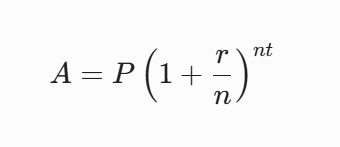
Here is what these variables mean in plain English:
- A (Amount): The final wealth you will accumulate.
- P (Principal): The initial amount of money you invest.
- r (Rate): The annual rate of return (as a decimal).
- n (Frequency): The number of times interest is compounded per year.
- t (Time): The number of years the money remains invested.
Notice where the t (Time) sits in the formula? It is an exponent. In mathematics, an exponent dictates exponential growth. This is the secret engine of compounding. While the rate of return is important, time is the most powerful variable in the entire equation.
Why Time Beats Timing: The Cost of Delay
One of the biggest misconceptions in personal finance is that you need a large sum of money to start investing. In reality, a small amount invested early will almost always beat a large amount invested later, purely because of the compounding effect.
Let us look at a practical Indian example to illustrate the staggering cost of delay. We will assume a hypothetical return of 12% per annum, which aligns with the long-term historical averages of Indian broad-market equity indices (though it is vital to remember that market returns are never guaranteed and fluctuate wildly in the short term).
Scenario: The Tale of Two Investors
Investor A (Aditi): The Early Bird
- Starts investing at age 25.
- Invests ₹5,000 per month via a Systematic Investment Plan (SIP).
- Stops investing at age 60.
- Total investment period: 35 years.
- Total money invested out of pocket: ₹21,000,000 (₹21 Lakhs).
- Estimated corpus at age 60 (at 12% p.a.): ₹3.2 Crores.
Investor B (Rohan): The Late Starter
- Waits until he is earning more and starts investing at age 35.
- Invests double the amount: ₹10,000 per month.
- Stops investing at age 60.
- Total investment period: 25 years.
- Total money invested out of pocket: ₹30,000,000 (₹30 Lakhs).
- Estimated corpus at age 60 (at 12% p.a.): ₹1.8 Crores.
The Takeaway:
Rohan invested ₹9 Lakhs more out of his own pocket than Aditi, and he invested double the monthly amount. Yet, at retirement, Aditi has nearly ₹1.4 Crores more than Rohan.
Why? Because Aditi’s money had 10 extra years to compound. In the later years of Aditi’s investment journey, the interest she was earning on her accumulated wealth was far greater than the actual ₹5,000 she was contributing each month.
The Three Pillars of Compounding
To successfully harness the power of compounding for wealth creation, you must build your financial habits around three non-negotiable pillars.
1. Start Early (Even if it is small)
As demonstrated by Aditi and Rohan, time is your greatest asset. Every day you delay is a day of lost exponential growth. You do not need to wait until your salary reaches a certain bracket or until you have cleared every minor debt. Starting with ₹1,000 a month in your twenties is infinitely better than starting with ₹10,000 a month in your late thirties.
2. Consistency (Systematic Investing)
Compounding thrives on a steady stream of capital. This is why tools like Systematic Investment Plans (SIPs) in mutual funds or regular contributions to the Public Provident Fund (PPF) are so effective. They automate your discipline. By investing a fixed amount every month, you remove emotion from the equation and continuously feed the compounding engine, regardless of whether the market is at an all-time high or in a temporary slump.
3. Unshakeable Patience
Human brains are wired to think linearly. If we take 10 steps, we expect to be 10 meters away. Compounding does not work like that. In the early years, the growth is incredibly slow and often boring. It feels like nothing is happening.
The “magic” of compounding usually does not reveal itself until the second or third decade of investing. The curve stays relatively flat for a long time before suddenly shooting upward like a hockey stick. You must have the patience to survive the flat, boring years to experience the explosive growth later.
How to Apply Compounding in the Indian Context
Understanding the math is useless without practical application. Here is how Indian investors typically harness compounding across different asset classes.
The Public Provident Fund (PPF)
The PPF is one of the most popular debt instruments in India, offering a sovereign guarantee and tax-free returns. Because it has a mandatory 15-year lock-in period, it essentially forces the investor to let their money compound. While the interest rates (determined by the government) are lower than equity markets, the sheer duration of the investment ensures significant, risk-free wealth accumulation.
Equity Mutual Funds (Growth Option)
When investing in mutual funds, investors are usually given a choice between the ‘Dividend’ (now called IDCW) option and the ‘Growth’ option.
- If you choose the dividend option, the fund pays out its profits to you.
- If you choose the Growth option, the fund automatically reinvests those profits back into the market.
To take advantage of compounding, wealth builders almost exclusively choose the Growth option, allowing the fund manager to reinvest the gains to buy more assets, which in turn generate more gains.
Direct Equities and Reinvesting Dividends
When you own shares of a fundamentally strong company, they often pay out a portion of their profits as dividends. If you spend those dividends, you break the compounding chain. If you use those dividends to buy more shares of the company, you accelerate your wealth creation.
The Dark Side: When Compounding Works Against You
Einstein’s quote noted that he who does not understand compounding, pays it.
Compounding is completely agnostic. It does not care if it is building your wealth or destroying it. When you take on high-interest debt, such as rolling over a credit card balance or taking out a high-cost personal loan, you become the victim of negative compounding.
Credit card companies often charge interest rates of 36% to 42% per annum, calculated on a daily or monthly basis. If you only pay the minimum due, the unpaid interest is added to your principal debt. The next month, you are charged interest on a higher amount. This can quickly spiral out of control, making it mathematically impossible to build wealth until that high-interest debt is aggressively cleared.
Common Mistakes That Kill Compounding
Even investors who understand the math often sabotage their own success due to behavioral errors. Here are the most common ways people interrupt the eighth wonder of the world:
1. The Urge to “Book Profits” Early
When a portfolio sees a 20% or 30% jump, the psychological urge to sell the investments and “lock in” the gains is immense. However, pulling money out of a performing asset to sit in cash effectively resets the compounding clock. Unless you have reached your specific financial goal, leaving the money invested is usually the better choice.
2. Stopping Investments During Market Crashes
Equity markets are volatile. Over a 20-year period, you will see multiple crashes, corrections, and economic panics. When the market drops, fear causes many investors to stop their SIPs or withdraw their money. This is the exact opposite of what you should do. Continuing to invest during market downturns means you are buying units at lower prices, which will compound powerfully when the market eventually recovers.
3. Ignoring Inflation and Taxes
Compounding must be viewed through the lens of purchasing power. If your investment compounds at 5% annually, but inflation is 6%, your real rate of return is negative—you are actually losing purchasing power over time. Furthermore, taxation eats into your final corpus. This is why investors must focus on tax-efficient, inflation-beating asset classes (like equities or equity mutual funds) for long-term wealth creation.
4. Frequent Portfolio Churning
Constantly switching from one mutual fund to another in search of the “best” return incurs exit loads, triggers capital gains taxes, and interrupts the compounding process. Wealth is built through long-term holding, not frantic trading.
Conclusion: The Ultimate Test of Character
The power of compounding is not a get-rich-quick scheme. It is the ultimate get-rich-surely strategy. It does not require a high IQ, inside information, or immense luck.
What it does require is character. It requires the discipline to save a portion of what you earn, the wisdom to invest it in productive assets, and the stoicism to leave it completely alone for decades.
At GrowSIP, we believe that understanding compounding is the foundational step in your personal growth and financial journey. It shifts your perspective from working hard for your money, to making your money work incredibly hard for you.
Plant the seed today. Water it with consistent contributions. And most importantly, give it the time it needs to grow into a tree that will provide shade for you and your family for generations to come.
Disclaimer: This article is for educational purposes only and should not be considered financial advice. Investors should evaluate their financial goals and risk profile before making investment decisions.